






Why Your Mini-Split Builds Up Ice During Peak Apex Humidity (And How We Safely Thaw It)
Discovering a Frozen Mini-Split During an Apex Summer
August in Central NC brings a heavy, oppressive heat. If you are searching for exactly why your mini-split builds up ice during peak Apex humidity (and how we safely thaw it), you are dealing with a frustrating but common late-summer issue that keeps our Fogg HVAC Inc. dispatchers busy every year. You might first notice the problem when your indoor unit starts blowing warm, muggy air instead of the crisp breeze you expect. Or, you might find water dripping steadily from the indoor chassis down your wall. When you finally open the front cover to investigate, the sight can be alarming: the entire grid of metal cooling coils is encased in a thick, solid block of ice.
Finding a frozen air conditioner in the middle of a sweltering afternoon immediately triggers a sense of panic. The immediate temptation is to grab a tool and start chipping the ice away so you can get the cold air flowing again. However, in our experience, a frozen mini-split is rarely a catastrophic mechanical failure; rather, it is a strict physics problem tied directly to local weather conditions and airflow. Understanding how this happens—and why you must resist the urge to scrape the ice off yourself—is the first step to restoring your home's comfort without destroying your equipment.
For more foundational information on keeping your entire home comfortable, review our guide to air conditioning systems.
The Physics of Condensation: Why Local Humidity Matters
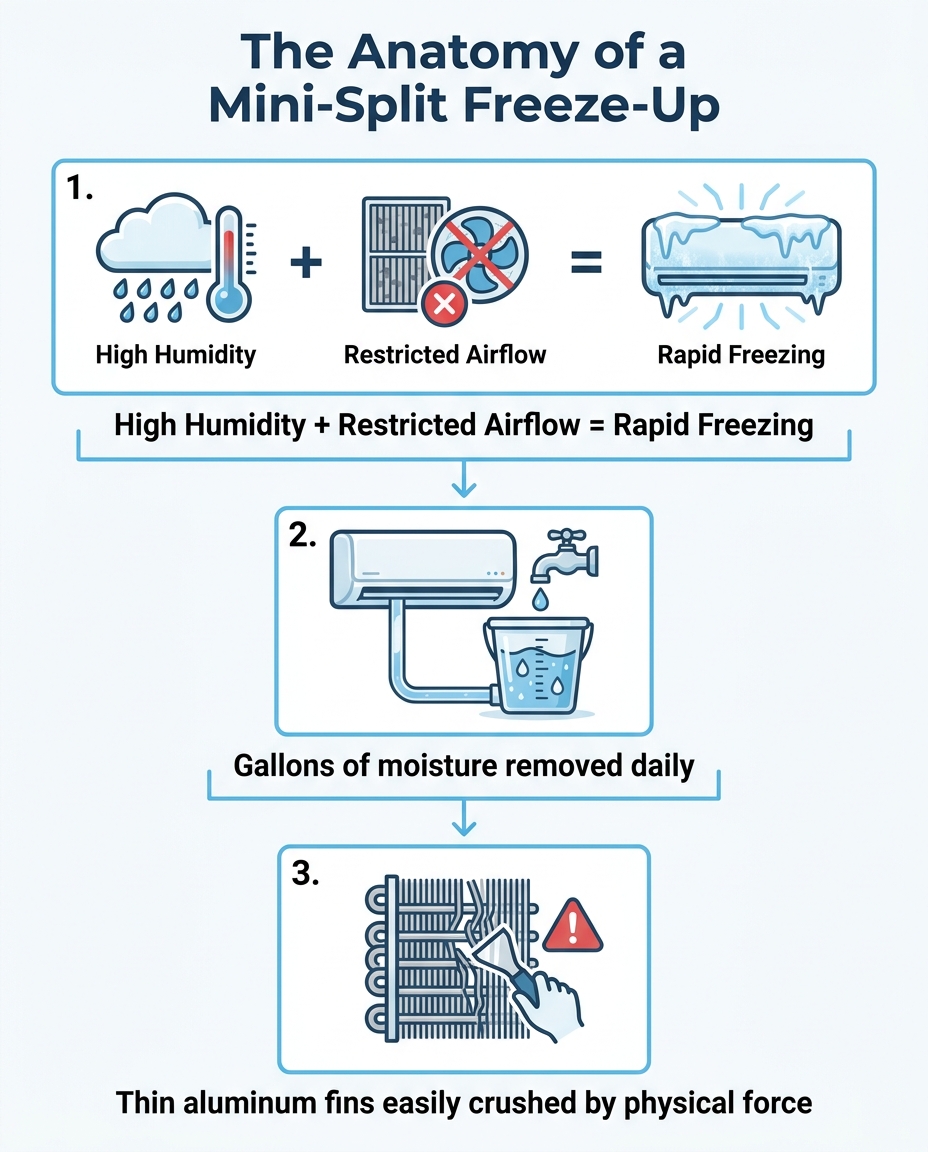
To understand why your system turns into an icebox, you have to look at what a ductless unit actually does. A functioning mini-split acts as a powerful dehumidifier while it cools. As warm room air is pulled into the unit, it passes over the freezing-cold evaporator coils. Because cold air cannot hold as much moisture as warm air, the water vapor in your home condenses into liquid water on the coils, drips into a drain pan, and exits your house. On a typical summer day, a standard system removes several gallons of moisture from your indoor air.
However, as our technicians see daily, August peak humidity in Central NC drastically changes the equation. During late summer, our region frequently experiences relative humidity levels exceeding 80 percent, accompanied by exceptionally high dew points. This heavy moisture load means the volume of condensation forming on your indoor coils is massive. The system is working overtime just to wring the water out of the air before it can even begin to lower the temperature.
The freezing process begins when a specific tipping point is reached: moisture accumulates on the metal faster than it can drip away, and the actual temperature of the coil drops below 32 degrees Fahrenheit. When this happens, the heavy condensation does not just drip into the pan—it flash-freezes directly onto the metal. Once a thin layer of frost forms, it acts as insulation, dropping the temperature even further and causing a rapid snowball effect until the entire unit is choked with solid ice. If your system is struggling under this moisture load, reaching out for professional mini-split repair and service is the safest way to restore proper operation.
What Causes a Mini Split to Freeze Up?
While high humidity provides the moisture required for ice, the actual trigger that drops the coil temperature below freezing usually traces back to a mechanical or maintenance issue. When homeowners search for why a mini split freezing up happens so quickly, our team at Fogg HVAC Inc. almost always traces the culprit back to one of two categories: restricted airflow or a refrigerant problem.
The Role of Restricted Airflow
Your mini-split relies on a constant, heavy volume of warm room air blowing over the cold coils to keep them above freezing. Without sufficient warm airflow, the condensation turns to ice almost immediately.
• Dirty air filters: The most common culprit we see during end-of-season cooling. Even a slightly clogged reusable filter acts like a wall, stopping warm air from reaching the coils and triggering a freeze-up under heavy moisture loads.
• Blocked evaporator coils: If dust and pet dander bypass the filter, they stick to the wet coils, creating an insulating blanket of grime that prevents proper heat transfer.
• Malfunctioning blower motors: If the internal fan mechanism is failing, spinning too slowly, or coated in heavy dust, it simply cannot push enough air across the system to keep the coils warm.
The Danger of Low Refrigerant
Air conditioning systems are closed loops; they do not "consume" or burn up refrigerant over time. If your system is low on refrigerant, it means there is a physical leak somewhere in the copper lines or connection flares.
• Pressure drops: Lower refrigerant levels cause a corresponding drop in pressure inside the evaporator coils.
• Sub-freezing temperatures: This drop in pressure forces the chemical temperature well below its designed operating range, instantly freezing the heavy August condensation upon contact.
Common Causes of Ice Build-Up Compared:
• Dirty Air Filter — Primary Symptom: Weak airflow, unit runs constantly — How Fast Ice Forms: Gradual (over a few days) — Professional Fix Required: Filter cleaning and airflow test
• Failing Blower Fan — Primary Symptom: Grinding noises, little to no air coming out — How Fast Ice Forms: Rapid (within hours) — Professional Fix Required: Motor replacement and wheel cleaning
• Low Refrigerant — Primary Symptom: Air feels room-temperature, hissing sound — How Fast Ice Forms: Very Rapid (flash freezing) — Professional Fix Required: Leak search, repair, and exact recharge

The Hidden Dangers of Chipping Ice Off Your AC Coils
When you are sweating in your living room, taking a butter knife or a screwdriver to the block of ice seems like the fastest way to get relief. In our years of rescuing ductless systems across Apex, we can confidently say this is the single most damaging thing a homeowner can do. The evaporator coils hidden behind that ice are not solid blocks of steel; they are constructed from hundreds of exceptionally thin, delicate aluminum fins.
These fins are spaced millimeters apart and are thinner than a soda can. They are designed this way to maximize the surface area for heat transfer. Because they are so fragile, scraping, picking, or chipping at the ice will easily crush, bend, or puncture them. Once these fins are mashed flat against each other, air can no longer pass through them. This permanently restricts the airflow, ruining the unit's efficiency and virtually guaranteeing that the system will freeze up again the next time you turn it on.
Furthermore, we strongly warn against using heat guns, hair dryers, or pouring boiling water over the indoor unit. Extreme, sudden temperature changes cause thermal shock. Boiling water can instantly crack the plastic housing, warp the drain pan, or short out the sensitive electronic control boards located just inches away from the coil. At Fogg HVAC Inc., our primary goal during a freeze-up call is protecting the homeowner's investment by preserving these delicate components, ensuring a minor airflow issue does not turn into a total system replacement.
Our Professional Process for Safely Thawing and Diagnosing
Resolving a frozen system requires patience and a methodical approach. The very first step is always turning the system completely off at the thermostat and the remote. Leaving a freezing unit running will only build a thicker wall of ice and eventually burn out the compressor outside.
When our technicians arrive at your home, we use safe, ambient-temperature methods to accelerate the thawing process without risking physical impact to the fins or thermal shock to the plastics. We ensure the drain pan is clear so the melting ice has a safe path out of your home, preventing water damage to your drywall or flooring.
Once the unit is completely thawed and dry, the real work begins. A comprehensive diagnostic is required to find the root cause. We test the blower motor speeds, measure electrical draws, and use specialized gauges to test for refrigerant leaks. We look at the entire system holistically. For example, our team recently worked with a homeowner who reached out in the fall needing to upgrade their existing system to accommodate a newly finished basement; during that project, we rerouted the flex ducting and discussed options to ensure the airflow was perfectly balanced throughout the space. That exact same attention to airflow dynamics is what we apply during a diagnostic to ensure your system won't immediately freeze again the next day.
If you are dealing with a solid block of ice right now, read our immediate steps on what to do when your mini-split freezes.
Preventing Ice Build-Up for the Rest of the Summer
Once your system is thawed and repaired, keeping it clear of ice for the remainder of the season comes down to consistent, proactive care. In our experience serving the Apex area, we've found that because mini-splits process so much air directly from your living space, they require more frequent attention than a traditional ducted system. As families transition into the busy back-to-school season, establishing a routine is key.
• Establish a strict filter schedule: Clean the reusable mesh filters in your indoor unit every two weeks, especially during peak late-summer usage when the system runs constantly.
• Keep the air path clear: Ensure the area around the indoor air handler is free of dust-collecting debris. Do not place tall furniture or curtains directly beneath the unit where they might impede the return air.
• Monitor for early warning signs: Pay attention to decreased cooling output, strange whistling noises from the blower, or water dripping from the indoor chassis, as these are the first indicators that airflow is dropping.
• Schedule regular deep cleanings: Rely on professional seasonal check-ups to clean the internal blower wheel and catch slow refrigerant leaks before they cause a freeze-up.
Staying ahead of these issues is simple when you rely on routine HVAC maintenance from a qualified professional.
Frequently Asked Questions About Mini-Split Ice Build-Up
Why is my mini split freezing up in the summer?
Your mini-split is freezing up because heavy summer condensation on the coils is dropping below 32 degrees due to restricted airflow or low refrigerant. When warm room air cannot properly reach the cold coils—usually because of a dirty filter—the moisture flash-freezes. In high humidity, this thin layer of frost rapidly builds into a solid block of ice.
How do you safely thaw a frozen mini split?
The safest way to thaw a frozen mini-split is to turn the system completely off and let the ice melt naturally at room temperature. You can run the unit on "fan-only" mode if your model allows it, which blows ambient air over the ice to speed up the process. Never use tools to scrape the ice, as this will destroy the delicate aluminum fins.
Can I pour hot water on my frozen AC to melt the ice?
No, you should never pour hot or boiling water onto a frozen air conditioner. The extreme temperature difference causes severe thermal shock that can crack the plastic drain pan, warp the housing, and permanently damage the sensitive electrical boards located near the coils.
Will a frozen mini split fix itself once turned off?
While turning the unit off will allow the ice to melt, it will not fix the underlying problem that caused the freeze-up in the first place. If you turn the system back on without cleaning the filters, clearing the blower wheel, or fixing a refrigerant leak, it will simply freeze solid again within a few hours.
Why is my mini split freezing up inside but not outside?
Ice builds up on the indoor unit during the summer because that is where the evaporator coil absorbs heat and collects indoor humidity. The outdoor unit exhausts the heat, so it remains hot during the summer cooling cycle. If the outdoor unit freezes, a pattern we typically see only happens during the winter heating mode.
How quickly can a dirty filter cause a mini-split to freeze?
During periods of extreme heat and high humidity, a severely clogged filter can cause a mini-split to freeze up in just a few days. Because the system is extracting gallons of water from the air daily, any significant drop in warm airflow allows that heavy condensation to freeze almost immediately.
Does high humidity in Apex make my mini-split more likely to freeze?
Yes, heavy late-summer humidity drastically increases the amount of moisture your mini-split must process. With more water condensing on the coils, there is a much smaller margin for error; even a minor airflow restriction that might go unnoticed in a dry climate will quickly trigger a freeze-up here.
Get Fast, Safe Relief for Your Frozen Mini-Split
A freezing ductless system is a clear sign that your equipment is struggling to breathe or maintain proper pressure, and unfortunately, it is an issue that will not fix itself. Ignoring the problem or attempting to force the unit to run while encased in ice will only lead to severe water damage inside your home or a burned-out compressor outside.
If you have discovered a block of ice under your unit's cover, the best immediate action is to turn the system off at the remote and contact a local expert. The team at Fogg HVAC Inc. is ready to safely thaw your equipment, perform a thorough diagnostic, and fix the root cause so you can get back to enjoying a cool, dry home. Reach out today to schedule your diagnostic visit and explore our comprehensive Apex HVAC services.
Customer Testimonial
Discover genuine feedback from homeowners who rely on us for reliable service and lasting results.


.png)
.png)
.png)
.png)
.png)
.png)
.png)
.png)
.png)
